
The Burning Grounds by Abir Mukherjee
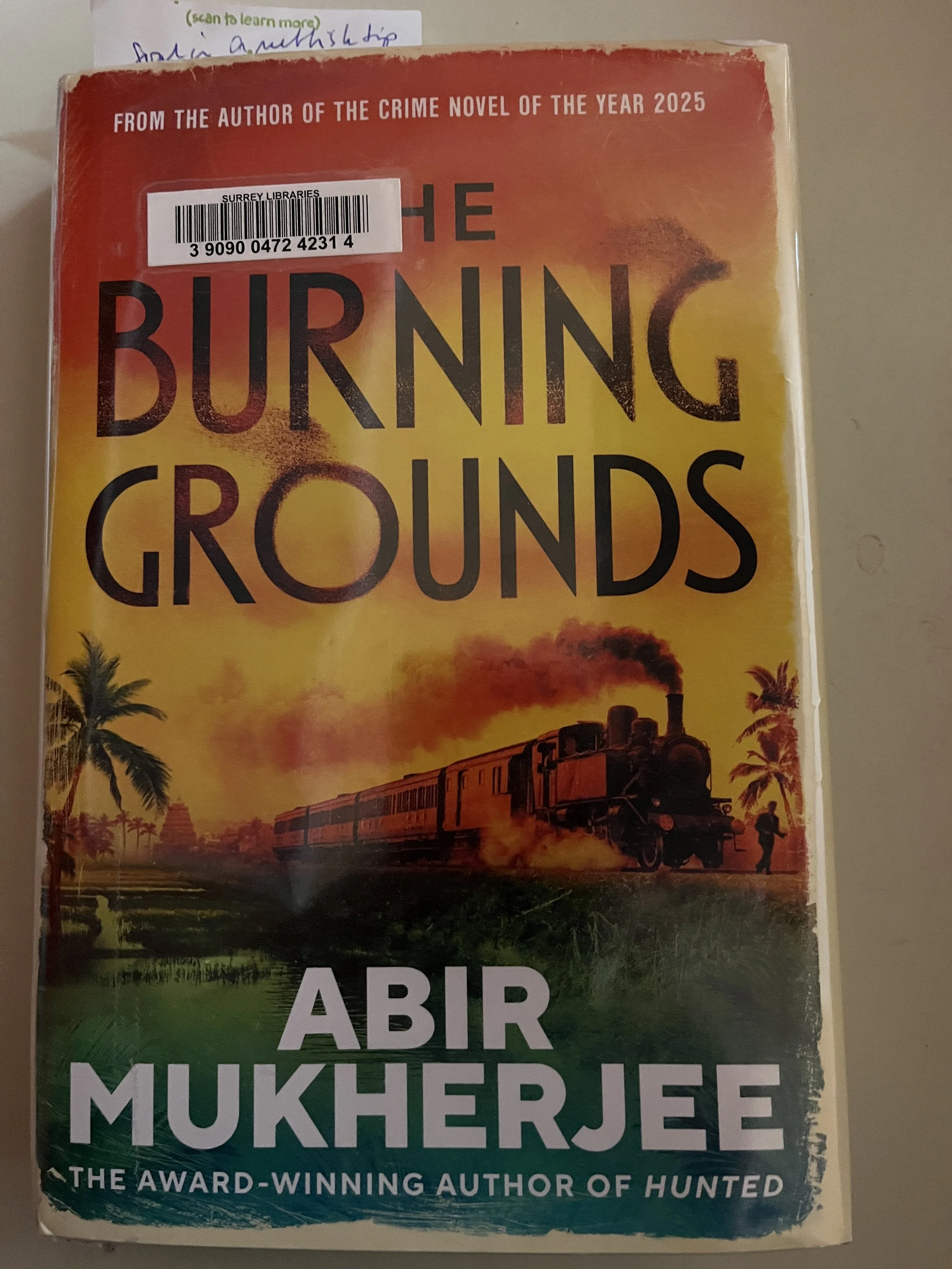
After finishing the The Shadows of Men, the last Wyndham and Bannerjee novel in 2021, I waited eagerly for the next to come out. In spite of their personal differences and the colonial atmosphere that shadowed their friendship, I hoped that Suren and Sam would work together again. It took four years, but The Burning Grounds proves a worthy successor to the previous five novels that portray Calcutta in the run-up to Indian Independence.
As always, Mukherjee delights readers with his character-appropriate language, which conjures the setting as well as portraying attitudes typical of the times. When the hard-drinking British policeman Sam Wyndham mentally describes his manservant as “grinning like a goat in a rubbish tip,” we are instantly transported to the time and place as well as being given a sharp glimpse of the personalities of the two and the relationship between them.
Sam’s description of the Great Eastern Hotel, graphic and humorous, puts the reader straight in the setting. It ends with the sardonic comment that the place could “give the Victoria Memorial a run for its money,” and “give your wallet palpitations.’ The decor, he suggests, “had probably left several acres of Burma treeless.”
The story is narrated alternately by Sam, and Suren, whose perspectives have been expanded by time spent in Europe. He describes himself as “older, and if not wiser, then at least more skeptical,” “sporting life’s bruises” upon his soul.
In a rut and marking time, Sam reads the daily papers. He feels doing so is “not particularly good for one’s health” but carries on “out of habit and because it’s always good to keep abreast of public opinion, even when public opinion borders on the stark raving mad.”
When Suren discovers his cousin has gone missing in circumstances apparently connected with the murder Sam is investigating, the two former colleagues join forces, somewhat reluctantly, to investigate both cases.
An actor Suren talks to about the murdered man, a wealthy public hero who was bankrolling a film, comments that the victim “was not all he was made out to be,” adding “You will be surprised how little a man’s reputation rests upon good deeds and how much upon good solicitors.”
As always, the author raises serious philosophical questions. In pondering his future and the coming independence of India, Suren reflects that “Freedom had always required violence,” and then wonders if Gandhi was right. “What if we could lift a people, hundreds of millions of men and women and children, from subjugation without the need for violence?…Would that not be a beacon, not just for Indians and Britishers, but for all mankind?”
An educated and thoughtful man, Suren thinks deeply about the relationship between British and Indians. He has a certain respect for the British, who are separated from other peoples by their willingness to reassess, even though it may take “a herculean effort to show them the error of their ways, they…generally get there in the end.” Perhaps, he thinks, the long relationship with India has tempered them in a way unique among European colonizers.
Today’s top-notch mystery writers are social commentators. Along with the Red Hot Chili Writers’ Vaseem Khan, who also writes about India, Abir Mukherjee is among the sharpest.