
The Hanging Garden by Ian Rankin
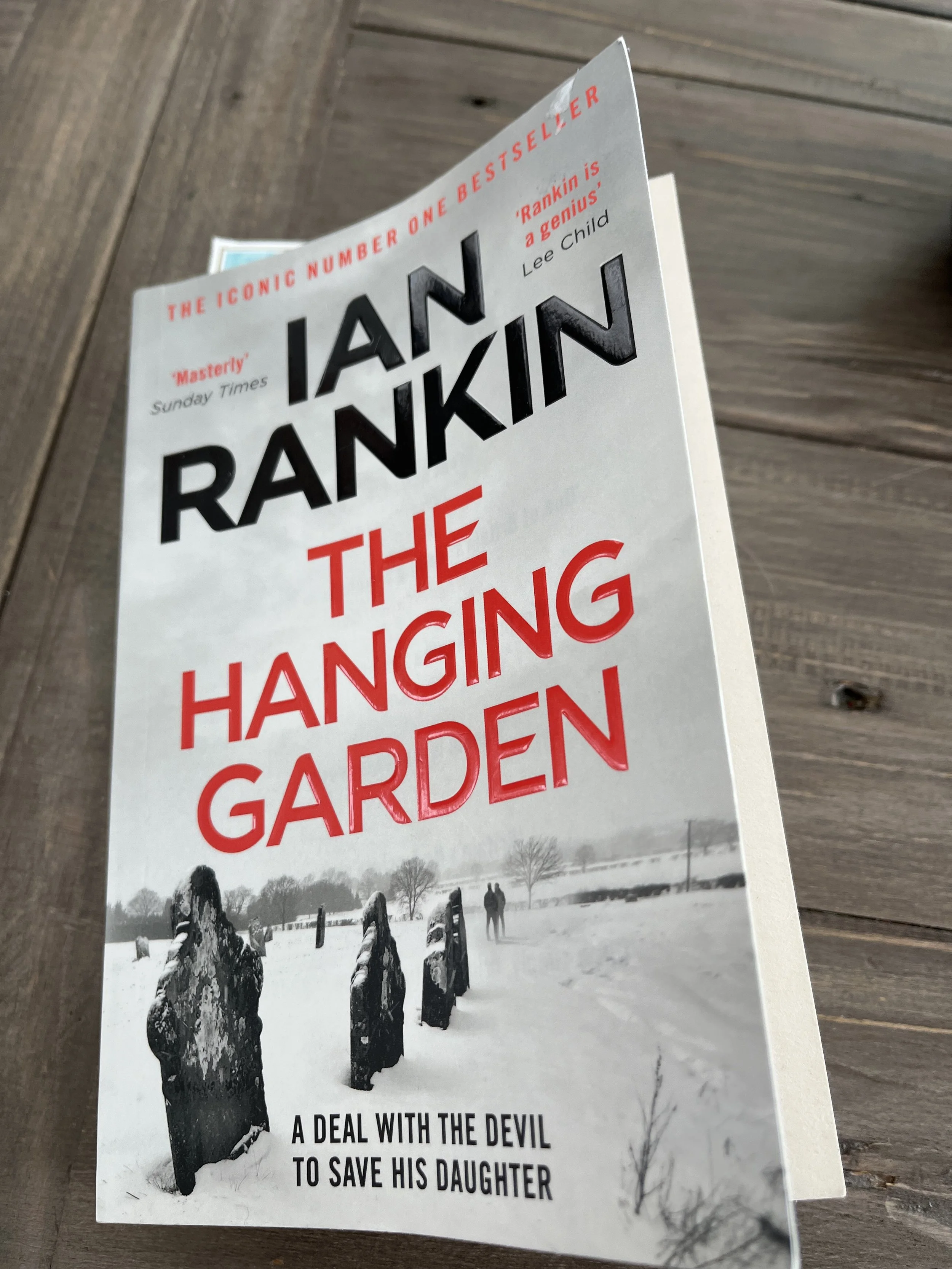
Wow. I thought I’d read all Ian Rankin’s Rebus books. Turned out I’d missed a crucial book in the series. The novel originally came out in 1998, but Rankin wrote the introduction to the volume I read in May 2005. In it, he voices the view that although “Academe and literary circles might not take the form seriously…the crime novel could say as much about human nature and the state of the world as any other writerly endeavour.”
In recent years, I believe the crime novel has become the leading form for portraying society—past as well as present—with all its warts and all its hopes. Along with Rankin, we must count the work of Val McDermid, Tana French and Kwei Quartey. Abir Mukherjee and Vaseem Khan portray history Moving beyond the UK and Ireland, we find exemplars of the form in Ghanaian-American novelist Kwei Quartey, Louise Erdhrich also come to mind, along with Donna Leon. Ovidia Yu’s Su Lin mysteries cast strong light on past times,
This novel deals with the aftermath of WWII, entertaining the questions like the Rat Line, a system that delivered Nazis “sometimes with the help of the Vatican—from their Soviet Persecutors.”
Brooding on the rumour that the notorious ‘Butcher of Lyon,’ Klaus Barbie, was “offered a job with British Intelligence” and “high-profile Nazis were spirited away to America,” detective John Rebus wonders why it took until 1987 for the UN to release the complete list of 40,000 “fugitive Nazi and Japanese war criminals.”
He concludes that in addition to the resistance of all concerned to reopening old wounds and the issue of what atrocities the Allies may have wanted to keep hidden, “modern politics had decreed that Germany and Japan were part of the global brotherhood of capitalism.”
Rebus, himself a veteran of the army who served in Northern Ireland, has read about all manner of outcomes for war criminals. While the likes of Eichmann and Barbie faces trials, others were able to return home and carry on with business as usual, others served sentences and truly changed.
Like the character in this story, who may or may not be the war criminal who ordered the wiping out of an entire French town, such reformed criminals tend to attribute the blame for their actions to war itself.
Rebus, who has been given this case to investigate against his wishes and outside his usual experience, is having a hard time working out whether the retired Ancient History professor Joseph Lintz is really the evil Josef Linzstek. After one of their conversations, he can’t help wondering “how easy it would be to put on an act, when you’d spent half a century practicing.”
In a later interview, he notices a painting on the professor’s wall. The old man it portrays has a look Rebus recognizes. A detective of long experience, he’s seen it before “when some suspect’s carefully crafted alibi had suddenly come tumbling down.”
Early in the novel, Rebus’s daughter Samantha is hospitalized with a serious head injury after being struck by a hit and run driver. While she lies unconscious, Rebus carries on investigating. It’s all he feels able to do, in particular because he suspects that the hit against his daughter was an attempt to get at him. In a telling conversation with the daughter of a man he wants to interview, the woman expresses frustration because she never knows where her Dad is or when he’ll be back.
“Well, you know, fathers,” he says, “if you don’t tell them anything’s wrong, they’re happy to assume the best and hold their peace.”
This economical scene, which conveys so much about Rebus’s character and background, filled in a lot of blanks for me. A longtime fan of the Rebus novels, I feel I know him better than ever.
In view of how police stories have become such popular vehicles for social commentary in recent years, I was also glad of the chance to read what Rankin had to say about this back in 2005.