
Enshittification by Cory Doctorow
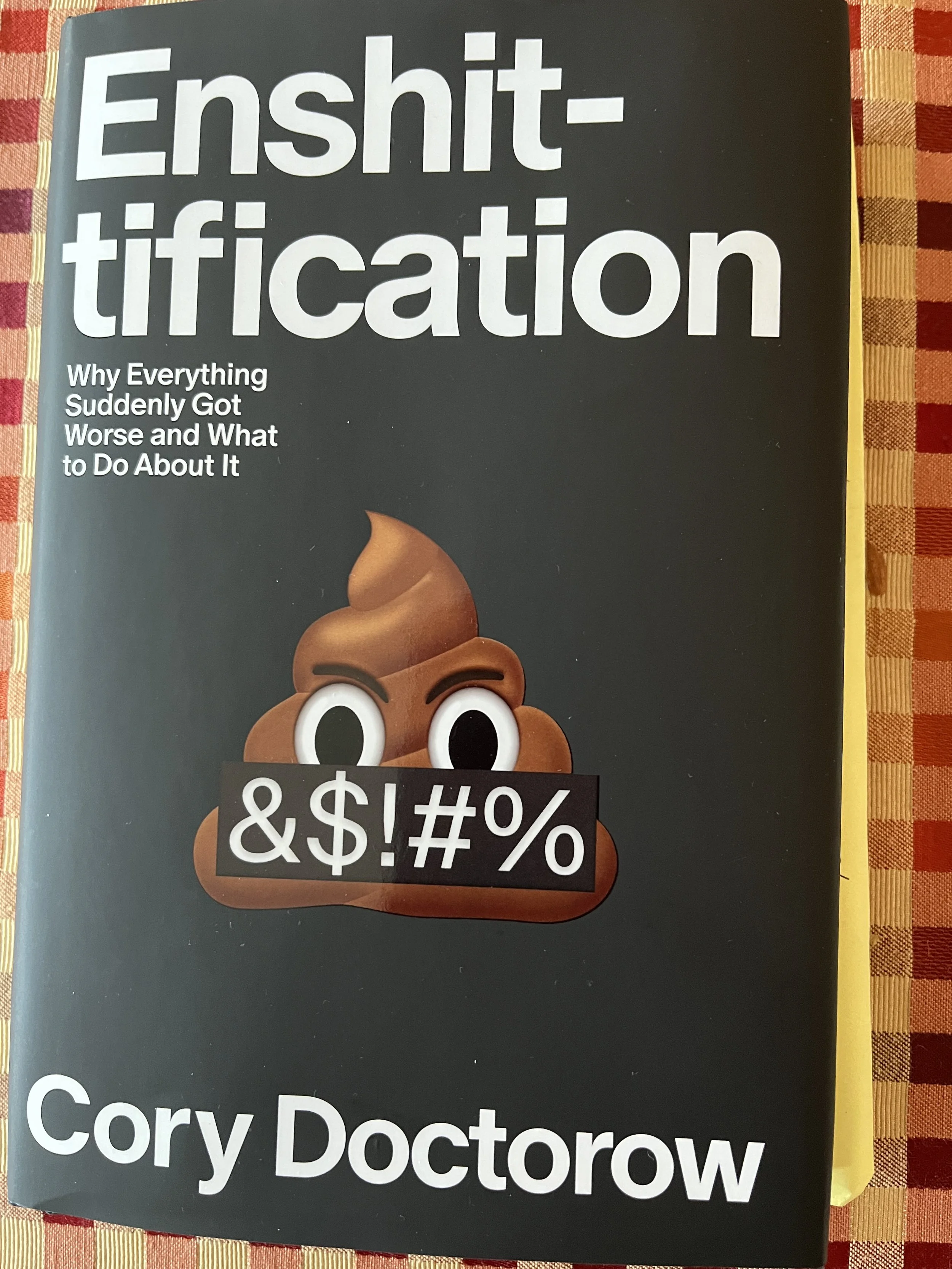
We are living through the Enshittocene, says the author, a period when the once-glorious internet has degenerated into “platforms” that rose to prominence and dominance because they were efficient and convenient. Now that businesses and users alike are locked into those services, the gloves are off, and the service down the tubes. Though the tone of the book is often humorous, the subject matter is utterly serious.
“On the old, good internet,” Doctorow reminds us, “people with a large dollop of technical knowledge, or a burning desire to acquire it, could meet with one another, conduct dialogues…inspire and frustrate one another, sell and buy from one another, and take action together—without needing permission from a handful of tech giants.”
Now that era of free interchange of ideas, goods, discussions and actions has been succeeded by the “enshitternet,” where half the traffic is now bots. On Thursday February 26, CBC Ideas will host a program entitled “The Internet is Dying. The internet is dead.”
This new internet regime is controlled by “unaccountable multinational tech firms that are largely or wholly insulated from any repercussions when they are malevolent, negligent, or just plain wrong.” Ordinary users—and non-users too—are feeling the pain.
Wonder why prices have gone through the roof? Anyone who sells on Amazon—and really, what business can afford not to?—must pay hefty fees. This means an Amazon seller ”Is being screwed out of 45 to 51 cents out of every dollar it earns on the platform.” No viable business can absorb that kind of cost without passing it on to the customer. Moreover, US trade laws means that when merchants raise prices on Amazon, they must raise them everywhere else. “If Amazon is taxing merchants 45 to 51 cents on every dollar they make, and if merchants are hiking their prices everywhere their goods are sold, then if follows that you’re paying the Amazon tax no matter where you shop.”
Monopoly-controlled price gouging is bad, but Doctorow’s well-researched book reveals a whole host of other hard social facts about the effects of the new enshitternet. From routinely lying to illegally spying, he gives numerous and egregious examples of malpractice by the monopoly tech giants. These include the cessation of selling us programs in favour of renting them. Now everything we use is owned by them. That way they can force us into unwanted upgrades and jack up subscription prices whenever they choose. Brutal labour practices are defended by spurious claims that “those people are not our employees; they’re working for the App.” Examples include Uber’s algorhythmic wage discrimination and the inhuman working conditions of Amazon drivers, who technically work for themselves.
Fortunately things are beginning to change, as described in final section of the book, “the Cure.” Based on the previous sections the Natural History (case studies Facebook, Amazon, iphone, and Twitter), The Pathology, and the Epidemiology, the author explains how the judicious use of regulation (in all kinds of jurisdictions), the return to an internet where self-help and cooperation are feasible, the revitalization of moribund American unions, and appropriate use of the courts. The book came out last year, and today we are watching Meta’s Mark Zuckerberg defend himself in a landmark civil trial—led by a 20-year-old plaintiff, complaining that the company deliberately engineered social media to addict children and teens.
Incidentally, Doctorow reminds us, “Facebook is a service Mark Zuckerberg started in his dorm room so that he and his creepy pals could nonconsensually rate the fuckability of their fellow Harvard undergrads.” The currently developing news story about the Zuckerberg trial reveals that he’s been caught on the back foot in his attempt to defend himself. What Meta denied ever doing two years ago has now been magically transformed into something they no longer do.
For the sake of profit, the monopoly flywheel has flung itself to the depths of corruption, and change is in the wind. “As the anti-monopoly movement gains ground all over the world, this new flywheel [of competition-enhancing regulation] is gaining momentum—without any big corporate donors, all thanks to people like you and me, who create the political will for big, ambitious regulatory adventures.” In a nice irony, we see Zuckerberg called to account in the state of California, home of Silicon Valley.
“Long before the United States started to seriously tackle Big Tech, European enforcers were handing out stonking fines and passing big, ambitious regulations.” The British Parliament recently passed a bill creating the Digital Markets Unit…the best-staffed technical competition unit in the world…The DMU is practically drowning in savvy engineers who can cut right through the nonsense and lay out the wrongdoing in pitiless and precise detail.”
Cory Doctorow, a Canadian born and raised in Toronto, is a journalist, blogger and activist who has worked for more than two decades with the Electronic Frontier Foundation on campaigns to safeguard and further human rights online. The author of thirty fiction and non-fiction books, Doctorow is a recipient of the Sir Arthur C. Clark Award for Imagination in Service to Society, among many other honours. Now living in California, he holds research and visiting professor appointments at the Open University, Cornell, the University of North Carolina, and MIT.
I was inspired to read this book after BC libraries hosted an interview with the author. The title and cover look depressing, but the subtitle had me hooked—especially the words “what to do about it.” Out last year, the book reports a groundswell of progress, and offers considerable hope.
Doctorow’s coining enshittification has officially entered the lexicon. In 1923, the American dialect society named it the word of the year.