
Lolly Willowes by Sylvia Townsend Warner
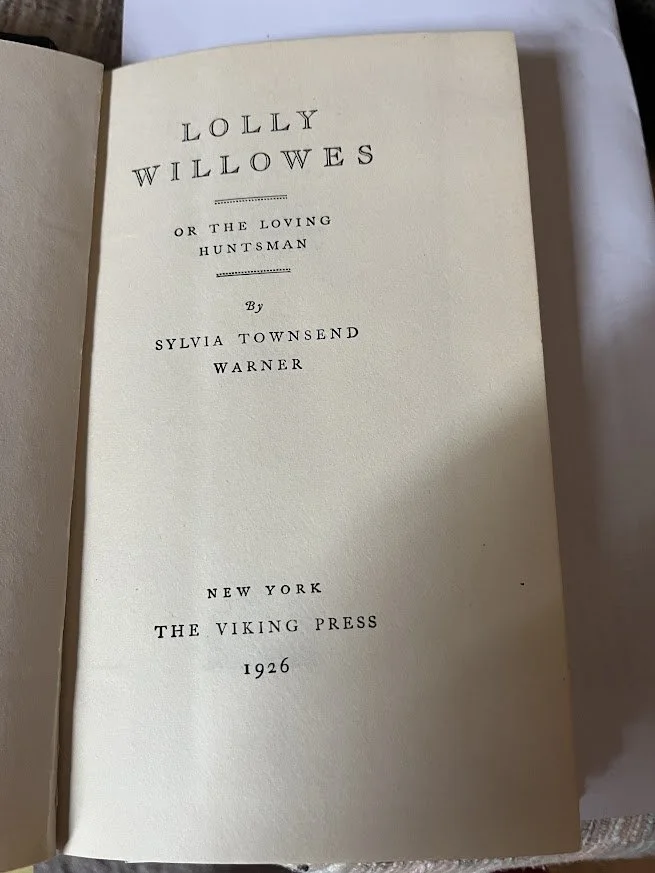
This novel was published a hundred years ago. Reading it made me ask myself what’s changed and what remains the same.
Certainly fiction technique is not the same. In our era with so much video and audio available, a somewhat slow-moving book with so much telling, so little dialogue, so few dramatic scenes, would hardly pass an agent or editor today.
Yet I found the story gripping. Having reached the age of 27 with a certain amount of freedom at the country home of her father, Laura’s life is turned upside down when her father’s death forces her out of her country home to live with her brother’s family in London.
Despite the goodwill on both sides, the maiden aunt chafes internally at the curtailment of her freedom. Being constantly “protected” from solitude causes her to suffer badly. After twenty years of suppressing her soul to follow the pattern of what well-meaning others think she should do and be, Aunt Lolly finally rebels, astonishing her kindly relatives. The reader, too, may be shocked by the manner in which she kicks off her chains; even so, there’s a satisfying inevitability to the thing.
The tone of light irony and the observations the author gives to Laura make the work amusing and relatable, in spite of the differences in setting, social mores and practices.
Discounted by her brother and his wife, who simultaneously pamper and use her, Laura reaches her own clear-eyed conclusion about their marriage. “Caroline had been very bad for his character…a good woman and a good wife, she yielded to Henry’s judgment in every dispute, she bowed her good sense to his will and blinkered her wider views in obedience to his prejudices.” This has the bad effect of “feeding his vanity and ministering to his imperiousness.”
In Laura’s view, the practice of law has also “done a great deal to spoil Henry,” endowing him with “a browbeating indifference to other people’s point of view.” However, he remains “kindly disposed to those who did not thwart him by word or deed,” and Caroline is “careful not to invite guests who are not of her husband’s way of thinking.”
In slavish obedience to the social practices of the time, Henry and Caroline go to some effort and expense to find a suitable husband for Laura. After disappointing them by failing to take to a series of “clean-shaven men with bristling eyebrows” who are “suavely concealing their doubts about her intelligence and probity,” she amazes Henry and Caroline by conversing comfortably with the awkward stammerer Mr. Arbuthnot, whom they have invited to tea “only out of pity.”
However, Mr. Arbuthnot has “a very good opinion of himself.” Deciding that at thirty-five “he owes himself a wife,” he feels Laura will “do very nicely.” Laura does not reciprocate his assessment. Though she’s willing to converse freely with him, she is certain “he will not do at all as a husband.” Accordingly she puts him off with a shockingly unsuitable remark.
After this, Henry and Caroline stop trying to match make, and things go on as before, with “Aunt Lolly” remaining an indispensable help with the children and the household. Two decades later, with her nieces and nephews grown, she makes a decision to alter her living arrangements. When she explains her plan to Henry, he initially tries to forbid it, saying, “You are my sister. I consider you my charge…It is not sensible. Or suitable.” Laura’s riposte to the suitability question and her insistence on having her way force Henry to reveal the embarrassing financial motive that underlies his argument against the “suitability” of her plan.
Laura’s leap towards independence makes her “humbler, and more simple.” She has evolved her philosophy, and she acts upon it. Though she feels her family have tyrannized her, there is “no question of forgiving them” since “the injury they had done her was not done by them. If she were to start forgiving, she must needs forgive Society, the Law, the Church, the History of Europe, the Old Testament, great-great-aunt Salome and her prayer book, the Bank of England…and half a dozen other useful props of civilization.” Her spiritual progress is reflected in her new ability to forget her persecutors “without flouting them by her forgetfulness.”
Laura’s approach to human problems that extend far beyond herself and her family has not grown stale in the century since this fascinating protagonist was first captured on the page. Cultures, religions and families continue to impose unjustifiable pressure on their members, and forgiveness remains a poor answer to such impositions. By seeming to raise the wronged person to a benevolent state of moral superiority, it allows the cycle of to continue. As Laura’s musings reveal, wrongs are often perpetrated by social practices rather than individuals. Moreover, abasing wrongdoers—who like Henry and Caroline, may have intended no harm—to recipients of benevolence from an apparently superior character causes resentment and discourages individuals from taking responsibility for their actions.