
A World Appears by Michael Pollin
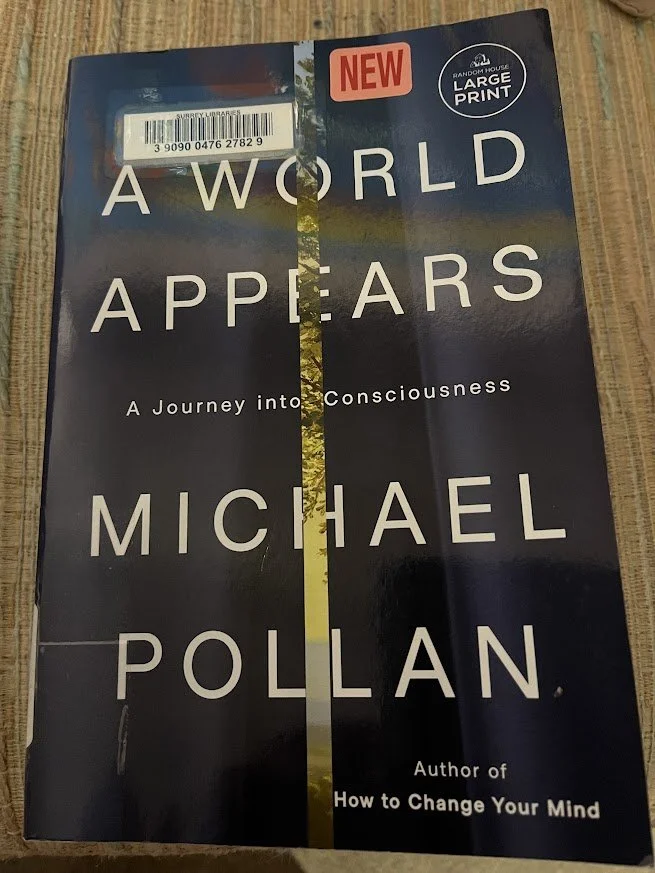
Reading this book was an education in current scientific and philosophical theories about the nature of consciousness. The philosopher Evan Thompson believes that modern Western culture has been “shaped by a conception of science framed in such a way as to render sentience in nature more or less invisible.” Unfortunately, this view has “given us license to treat nature as an exploitable resource” and lose “our empathetic resonance with the larger universe.”
This narrow perspective on consciousness is recent. Charles Darwin, who published The Origin of Species in 1859, “had a deep appreciation for the intelligence of plants,” likening the root tip to the brain of an animal.
Contemporary science is “making steady progress in overcoming its anthropocentrism,” Pollin tells, us. In 2012, a group of scientists and philosophers gathered to attempt “on what species besides our own” were conscious. The outcome was the Cambridge Declaration of Consciousness, declaring that along with humans, mammals and birds were conscious. Twelve years later, in New York, the conscious creature list was extended to include all vertebrates and many invertebrates. It’s a beginning, says Pollin.
The author also weighs in on the controversy over whether machine consciousness is possible.* “Cognition and intelligence traffic in information, which can be digitized and computed,” he says. However, “sensations and the subjective point of view, which sit at the heart of both sentience and consciousness, cannot.”
While he admits that “computer-simulated thoughts can do what real thoughts do,” he questions whether computer-simulated feelings qualify as real feelings. The question here is whether feelings depend on having a body.
According to neurologist Antonio Damasio, “feelings are the vital bridge linking mind and body, a mental phenomenon deeply rooted in our flesh.” He told the author that during his early research into feelings and emotions, when behaviorism and then cognitive psychology reigned, his field of inquiry was seen by other scientists (nearly all men) as “disreputable.” They maintained the stereotyped view that “emotions and feelings were feminine, and not as serious or useful…as rational thought.”
The accepted view held that rationality was located in the central cortex, the most recently evolved part of the brain. Damasio proposed that it arose in the older brainstem. We tend to think of the body as a support system for the brain; actually, the opposite is true.” Homeostasis is more than a physical state; it applies to the emotions as well, and works through consciousness.
Scientists have long assumed “physicality,” that consciousness is located in, or generated by, our brains. This view, which has never been proven, is no longer viable for neuroscientist Christoph Koch. He rejects it for three reasons. First it “fails to explain or even deal with consciousness. Second, quantum theory has “shattered scientists’ confidence that they can say with any certainty what matter is, exactly, or how it behaves. The discovery that two particles separated by vast distances can instantaneously exert an influence on each other—has shredded…the assumption that an object can only be directly influenced by its immediate surroundings.” Koch’s third reason for abandoning physicalism is his own direct experience of Mind at Large. This took place during an ayahuasca ceremony in Brazil, completely upending his worldview.
Numerous other scientists going back to Aldous Huxley have experimented with taking mind-altering drugs as a doorway to the experience of a unified consciousness that exists beyond individual minds. However, drugs are by no means the only path to this wider consciousness, which has been experienced and reported on by many people from many cultures for many centuries.
On completing his book after five years trying to understand consciousness, Pollin is unable to produce “the definitive theory or clinching argument” he’d hoped for. After all, how can you study consciousness when it is the very tool needed to study with?
By the end of his journey, the author is able to offers the reader his observation that the miracle of “consciousness remains the deepest of mysteries.” How is it that when “I open my eyes and a world appears?”
*Interestingly, “the whole field of cognitive neuroscience traces its origins to the advent of the computer in the 1940s, and with it, the rise of the brain-as-computer metaphor.”