
Starry Nights at the Trottier Observatory: a higher perspective
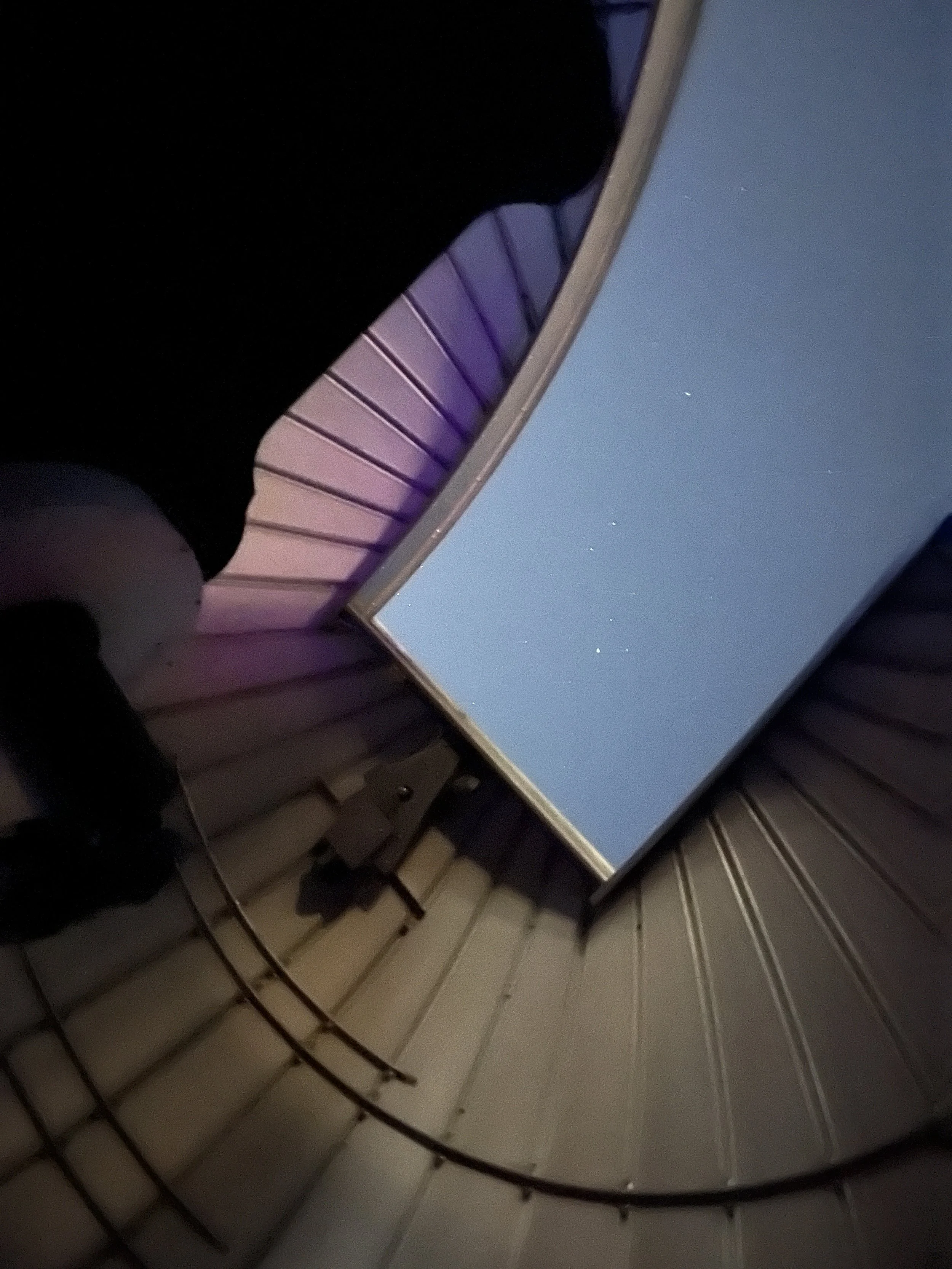
As the sky map on the computer is adjusted, it moves the window of the observatory so the portion of the sky highlighted on the screen
Since childhood I’ve loved looking at the night sky. Though I know little enough about astronomy, Starry Nights on Burnaby Mountain had long been on my radar. On a cool clear evening, I finally attended the event. Waiting to enter the room housing the big telescope, I looked through one of the external telescopes and saw a comet.
“Where’s the tail?” I asked, and was told it was not very visible.
At another station, an amateur astronomer showed me the Crescent nebula in Cygnus. He explained that it was an emission nebula, a gaseous shell formed by the stellar winds emitted by a dying star. I was astonished. Stellar winds?
Another telescope was focused on the ring nebula. “Look to the side rather than directly at it,” advised the astronomer. “That brings more light into your eyes.”
My number was called and I went in to the big telescope. Sitting on the stool to gaze through the scope at the planet Saturn, I was impressed by the clear view of its rings and moons.
It was getting chilly and Jupiter had not yet risen. When I learned it would be a couple of hours before the Pleiades got far enough above the horizon to be seen, I decided to go. As I walked back toward the parking lot, I decided I must bring my grandson, age three, to look through the telescope and see the stars. At that very moment, a woman spoke to me.
“Can you tell me how to get to the Observatory?”
I pointed it out, adding “I got a really good look at Saturn.”
She thanked me for the directions, adding “My four-year-old will be thrilled.”
Walking toward my car, I reflected that our lives are as nebulous as the elusive tail of the comet. Earth is the tiniest speck in the vastness of space.
Why is it that from an early age, we are fascinated by the stars?
Wordsworth’s lines floated into my mind,
“Our birth is but a sleep and a forgetting. The soul that rises with us, our life’s star, has elsewhere had its setting, and cometh from afar…”With all the knowledge we’ve collected, we humans tend to forget that life itself is a mystery. Amid plentiful evidence of unseen effects and unexplained connections, we look at life through a single scientific lens and deny that the universe itself is alive and intelligent and evolving.
Doing crosswords today, I learned a little more about the solar system. Jupiter is mostly made of gas and comets consist largely of ice. Connections are everywhere.
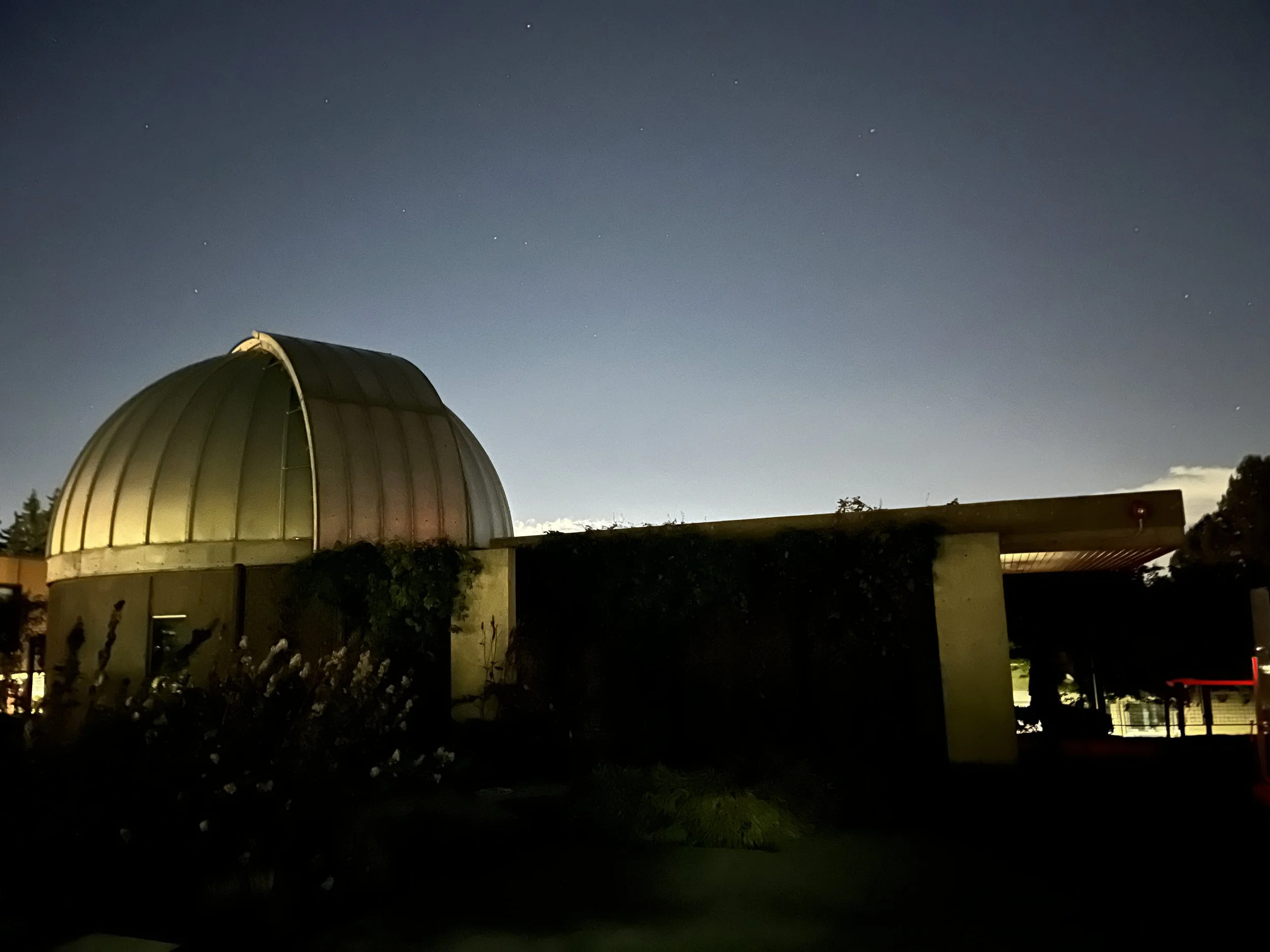
Trottier Observatory, Simon Fraser University, Burnaby, Canada