
A Mental Conversation with Rebecca Solnit’s Ideas
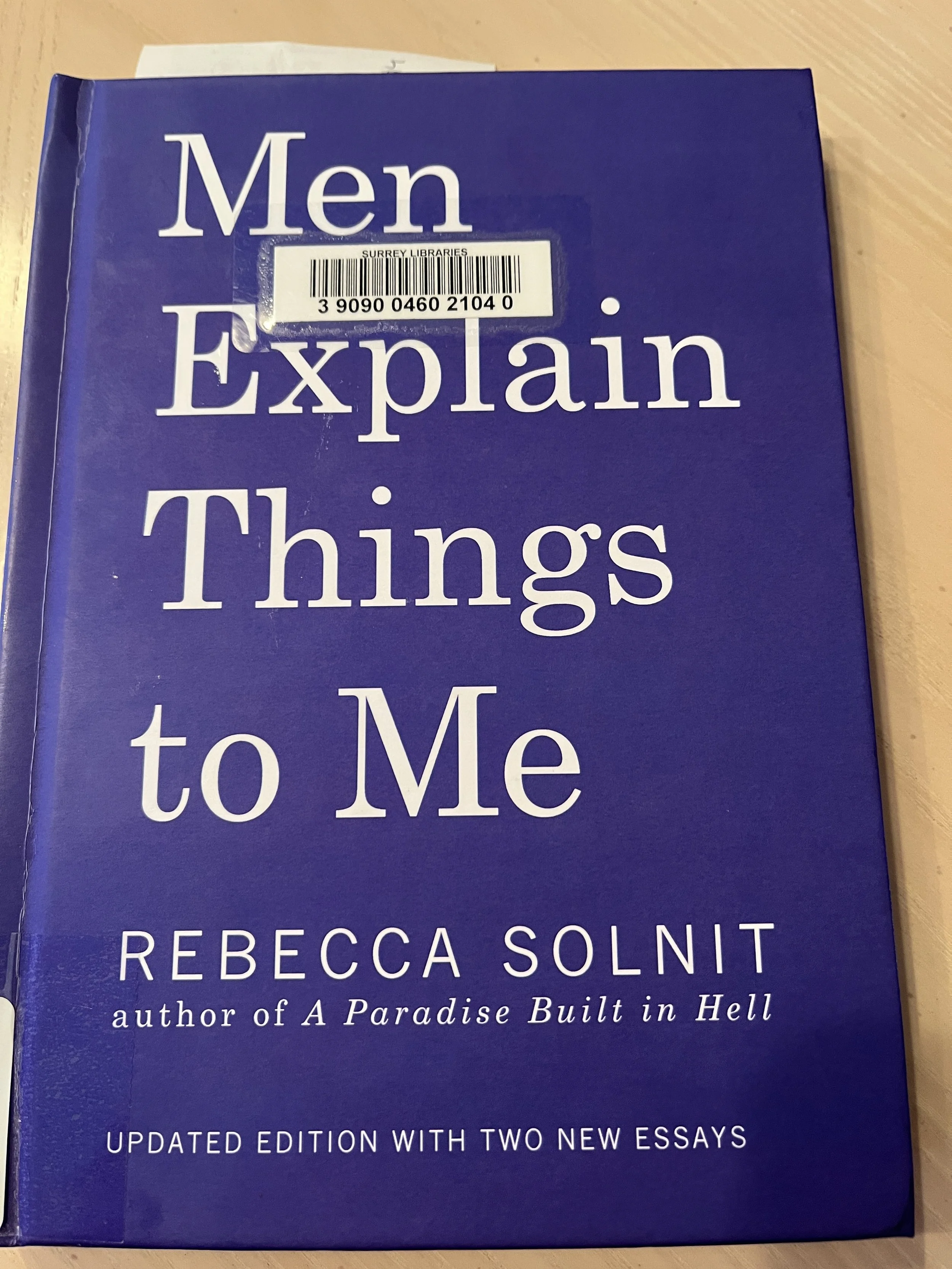
For some reason, I expected this book to be funny. Beyond a hilarious incident described in the opening essay, it was anything but. Also unexpectedly, it proved a page turner—hardly what one expects from a book of essays.
I’ve just returned from a walk in that “irresponsible evening hour” Solnit tells us Virginia Woolf loved so much. Geese called to each other, the tang of autumn leaves rose from the path, and a rain shower was made visible by the flame of sunset against a blue sky. The last rays cast one of the lushest rainbows I’ve ever seen. Both Woolf and Solnit believe walking frees the imagination.
Much of Solnit’s thought resonated deeply. “The long arc of history,” produces “unintended consequences, delayed impacts.” Among these are the influences of earlier writers like Woolf on those who come after, including Susan Sontag and Solnit herself.
In defending the art of literary criticism, she points out that “what escapes categorization can escape detection altogether.” Good criticism “seeks to expand the work of art, by connecting it, opening up its meanings,” and can even liberate it “to be seen fully, to remain alive, to engage in a conversation that will “keep feeding the imagination.”
Her own quest has been “to try to find or make a language to describe the subtleties, the incalculables, the pleasures and meanings—impossible to categorize—at the heart of things.” Since it’s difficult or “even impossible to value what cannot be named or described…the task of naming and describing is is an essential one in any revolt against the status quo of capitalism and consumerism.”
Her statement that “the destruction of Earth is due in part…to a failure of imagination” reminded me of a similar assessment made by the novelist Elif Shafak, who values diversity of thought, considering it essential to help us collectively address the deeply interconnected problems of sexism, autocracy, world hunger and thirst and environmental degradation.
Solnit says that the failure of imagination fuels the failure of “systems of accounting that can’t count what matters” and “the revolt against this is a revolt of the imagination, in favour of subtleties, of pleasures money can’t buy and corporations can’t command, of being producers rather than consumers of meaning, of the slow, the meandering, the digressive, the exploratory, the numinous, the uncertain.”
These days it is commonplace for people to assume they know the future, and that it will be dark, meaning bad. Yet as Solnit reminds us, “we always act in the dark” and “the effects of your actions may unfold in ways you cannot foresee or even imagine” even “long after your death” which is “when the words of so many writers often resonate most.” In the face of some pretty horrifying facts, Solnit refuses to succumb to pessimism. “The grounds for hope are simply that we don’t know what will happen next, and that the unlikely and the unimaginable transpire quite regularly.” Hear hear.
“Thanks to demographics, she reminds us, “the conservative push is not going to work—the United States is not going to be a mostly white country again”—and because “genies don’t go back into bottles and queer people are not going back into the closet and women aren’t going to surrender.” She imagines the future as a place where we must add to feminism “a deeper inquiry into men.” For women and men alike to see how “the status quo damages men” needs to include “an inquiry into the men perpetrating most of the violence, the threats, the hatred…and the culture that encourages them.” I would add the pre-programmed family systems (and not just in America) that produce them.
I find her statement of purpose inspiring. “To spin the web and not be caught in it…to create your own life…to name the grandmothers as well as the fathers, to draw nets and not just straight lines, to be a maker as well as a cleaner, to be able to sing and not be silenced, to take down the veil and appear: all thse are the banners on the laundry line I hang out.”
Reading Solnit’s book, I felt some of my offhand judgments dissolving as I thought more deeply about human problems. Thinking along unaccustomed lines brought to mind John Boyne’s recent book The Elements. Set in contemporary Ireland, it portrays the damage done to women by the prevailing culture at the same time revealing how existing norms are deeply damaging to men. The simple black and white categories of Innocence and guilt fail to take into account the deep complexities of how things go wrong.
In Boyne’s story, one man commits a crime, and his employers—who make money off his stellar sporting ability—collude with clever lawyers to get him off. But he cannot ultimately let himself off the hook. Another man, found guilty and jailed for proven sexual crimes against children including his own daughter, continues to deny his actions throughout his prison term. I was reminded of Gerry Adams, who has steadfastly denied his involvement as an IRA leader in the face of mounting evidence including fellow members naming him as their officer commanding.
One of Boyne’s female characters cannot forgive what was done to her in childhood. On the one hand a successful adult and a useful member of society, she still takes out her rage on innocent strangers, Other female characters find ways of coming to peace with their past. At the individual level, Boyne’s characters react differently to their traumatic experiences. At the same time, his story draws our attention to the indisputable reality that while people are given, and accept individual responsibility, many crimes and misdeeds arise out of a toxic cultural reliance on shame, silence and secrecy. This leads to abuses of power that contaminate us all.
Yet it behooves us to remember that our planet is a marvellous place, a tiny part of the vast and intelligent but unknowable universe. Along with that universe, we humans are evolving. Many claim they can predict the future, but such prognostications are only misguided attempts to imprint it with images from the past. We really have no idea of what is coming, and it behooves us to meet the moments we share with grace and gratitude.