
Frame 37 by Nicholas Shakespeare
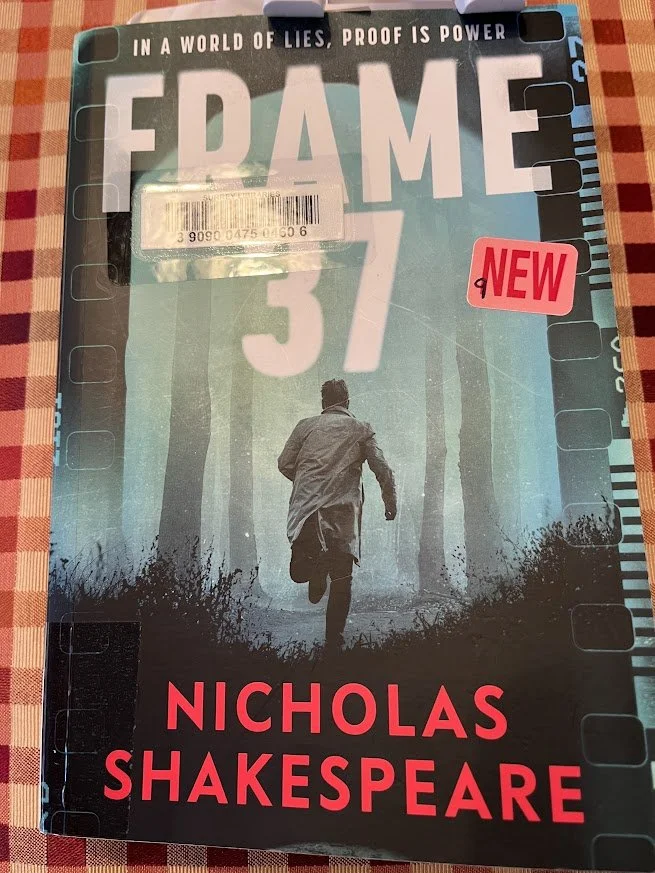
“The best stories can’t be told.” So concludes middle-aged former investigative journalist John Dyer. After his paper closed the South America bureau, he returned to England and settled down to make his living another way.
He’s working on a book when he receives an urgent call from his old compadre, the Brazilian photographer Miguel. Come and see me, his friend pleads. I have a story I don’t dare tell you over the phone. But when John arrives, his friend is dead—a murder made to look like suicide.
Compelled to follow this dangerous story to the end, Dyer must revisit a part of his young life he has put in the past: a woman he once loved relegated to an “amnesiac box.” He was too shy to court her before he burst in with three others to stop her being raped. Afterwards, she rebuffed him, would speak to no one.
But Miguel always carried his camera, always took pictures. He used to say that unlike digital pictures, photos taken on film can’t lie—there’s always the negative as proof. To stay alive and dig up the story his friend didn’t live to tell, John has to find that photographic evidence.
Our trip into the shadowy world of the political lobbyist gives us a few facts along with the fiction. A hundred million for a U.S. political campaign. Name changes. JD Vance has changed his name several times. He’s not the only one. Gary Hart, a Democratic senator from Colorado who ran twice for the presidential nomination in the eighties, was originally called Gary Warren Hartpence.
Optics is everything. The fictional fixers focus on the candidate’s appearance and deciding the face is okay, but the “dimples have to go.” Moral behaviour is far less important. Discussing the suitability of the chosen man with another lobbyist, the power broker Warmuth is told “We can’t have another president who’s a rapist. I mean we can…but not yet.”
Terrifyingly contemporary, this story portrays fictional lobbyists and fixers who power will stop at nothing to get “their” presidential candidate in place. Before the new man can be washed clean and endorsed, however, Warmuth needs to know the dirt about his past. Recognizing that the candidate is holding something back, he still feels “some admiration” for how “this small-town senator can twist the truth so convincingly.” This reassures him that he “might be the right man for the job.”
Shakespeare’s description of fictional ex-president, Howard J. Ockloss, is chillingly evocative of someone we hear about on the news constantly: “emblematic of an unprincipled Dark Age shallowness, a reductive placard to which only an optical illusion could add dimension.”
The story also takes us into Canada, where we’re shown the struggles of aboriginal people against the after-effects of the nation’s colonial past, and John’s friends efforts to help them. In Thunder Bay, we glimpse a statue of Canada’s only hero, Terry Fox, interviewed by Dyer during his attempt to run across Canada to raise funds for cancer. Both were young at the time. “Journalism is a young man’s profession.”
The book is dedicated to the author’s fellow-journalists at the Buenos Aires Herald who covered Argentina’s Dirty War.
This epigraph is also instructive. A quotation from A State of Fear, by Andrew Graham-Yooll: Only if someone writes this as fiction will it last; will it be believed.”