
Steeple Chasing by Peter Ross
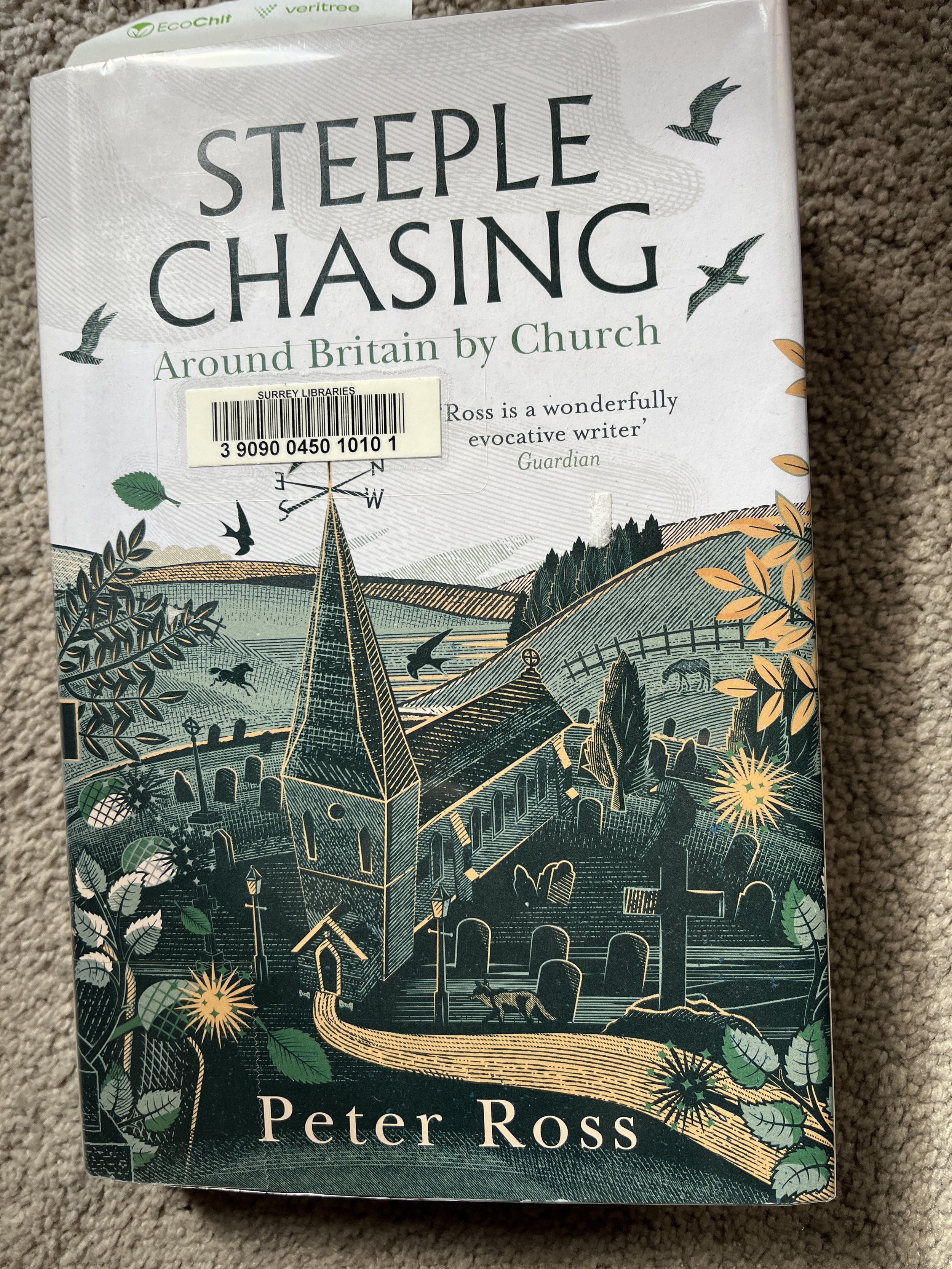
This book recounts a series of church visits undertaken by the author during COVID. Sensing the fragility in “rickety old Britain,” Ross admits being “tired of the present with its anger and fear and lies,” even “losing faith in the future.” For refuge, he delves into his country’s past, hoping to “be braced by history.”
Twice renewed from the library, this book had been sitting on my table for weeks when I finally picked it up. Should I return it and reduce my to be read pile? Before deciding, I opened it, and was immediately hooked.
Ross’s journey is not the tale of a religious pilgrimage, but rather “a close examination of churches and the customs associated with them.” These familiar landmarks are filled with art and architectural wonders. “People once loved and feared churches as they loved and feared God,” Ross tells us. “Now they often fear for them. Fear that they will fall down, or…be converted into offices and flats.”
Heaven forbid. Churches are sacred spaces filled with spiritual energy and many of those he describes have stood for a thousand years, buttressing one generation after another of the communities they serve.
As a Canadian, I’ve seen few of the thousands of churches in Britain, and only a handful of the 43 cathedrals. Pluscarden Abbey, a name that sounded vaguely familiar, turns out to be a monastery in remote Northern Scotland. Founded in 1230, it fell into disuse after the Reformation and remained that way until 1948.
Today, Father Giles explains, the monks who live and work there see themselves as social activists. Paradoxically, they participate in the world by withdrawing from it. Comparable to a hydroelectric dam that provides spiritual energy and support to a distant community, it’s “a prayer factory,” with “the workers grafting day and night on behalf of all mankind.”
This is done through rigorous song and prayer. Several times a day, the monks sing medieval Gregorian chants. Reading about this put me in mind of a Gregorian chant phase I went through a few years back. Though I belong to no religious community, I somehow conceived a deep hunger to hear these Latin chants. Alone in my car, I played them repeatedly, I knew not why. The Latin words were unintelligible to me, and I was surprised to learn how old they were.
Back in London, Ross visits St. Paul’s and tells us about The St. Paul’s Watch. Formed in September 1939, this group of 80 volunteers came from all over London to patrol the cathedral between 9:30 pm and 6:30 am. Far more vulnerable than it looks, the dome is “a skin of lead stretched over a timber frame. During the blitz, the watch climbed around the roof with stirrup pumps putting out countless fires started by incendiary bombs. “Members of the Watch had to memorize the maze-like layout from crypt to dome,” both to navigate in the dark. They also had to be prepared “to improvise alternative routes to get around blockages caused by fire or fallen stone.
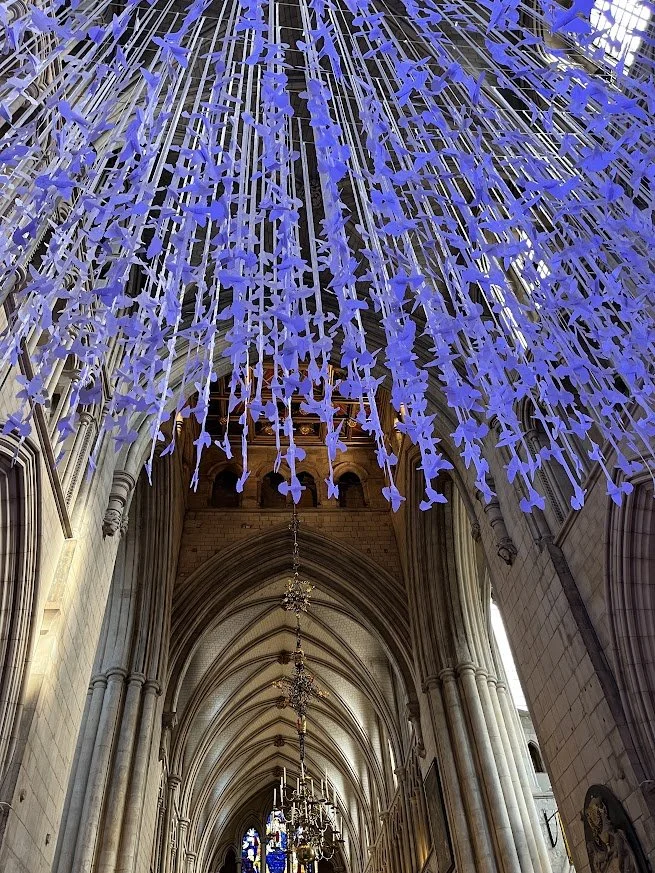
Southwark Cathedral in September 2025 with Peace Doves, a mass participation art display by Peter Walker
Along with resident rats and bats, cats have a long history with cathedrals. Last year, I visited Southwark Cathedral in London for the second time since 1973. This ancient place of worship, mentioned in the Domesday book (1086), now stands cheek by jowl with Borough Market and close to the Shard. A feral cat called Doorkins Magnificat adopted the cathedral as her home, kept it rodent-free, and entranced a great many visitors. After dying of old age, she was buried with ceremony by the church wall.
In one church, Peter Ross had the good fortune to witness a baby’s baptism using an enormous 1000-year-old font bedecked with Viking style carving on its sides. At Gloucester Cathedral, he watched a team of six masons doing stone work. They work constantly to replace damaged features, repair statues and even make new gargoyles. They also made a new lintel that has allowed the Lady Chapel to be Pascal, the chief mason, trained in France by Les Companions du Devoir (the journeymen of duty), is no longer a practising Christian. He considers stonework both a calling and a form of prayer.
At a beautiful church in Kilpeck, Ross was shown a Sheela-na-gig. This emphatically feminine sexual image is one of several in England; Ireland has more. The origin of this symbol is uncertain—perhaps a pre-Christian folk deity, but definitely part of medieval Christianity. Even today, people use them as amulets to assist with fertility issues.
As attendance drops, maintaining churches becomes increasingly unaffordable and many have been closing. Doing their best to slow this trend, a charity called Friends of Friendless Churches has stepped in to befriend them.
Ecclesiologist John Vigar is a non-believer. Fascinated by church buildings, he visits about 700 churches in a year. Fascinated by these repositories of living history, he has developed an enormous and growing expertise for leading tours, giving lectures, and writing books about churches. His left arm is tattooed with images of saints from his favourite stained glass windows, and his mission in life is “showing people what they wouldn’t otherwise see.”