
Pinnacle by Abir Mukherjee
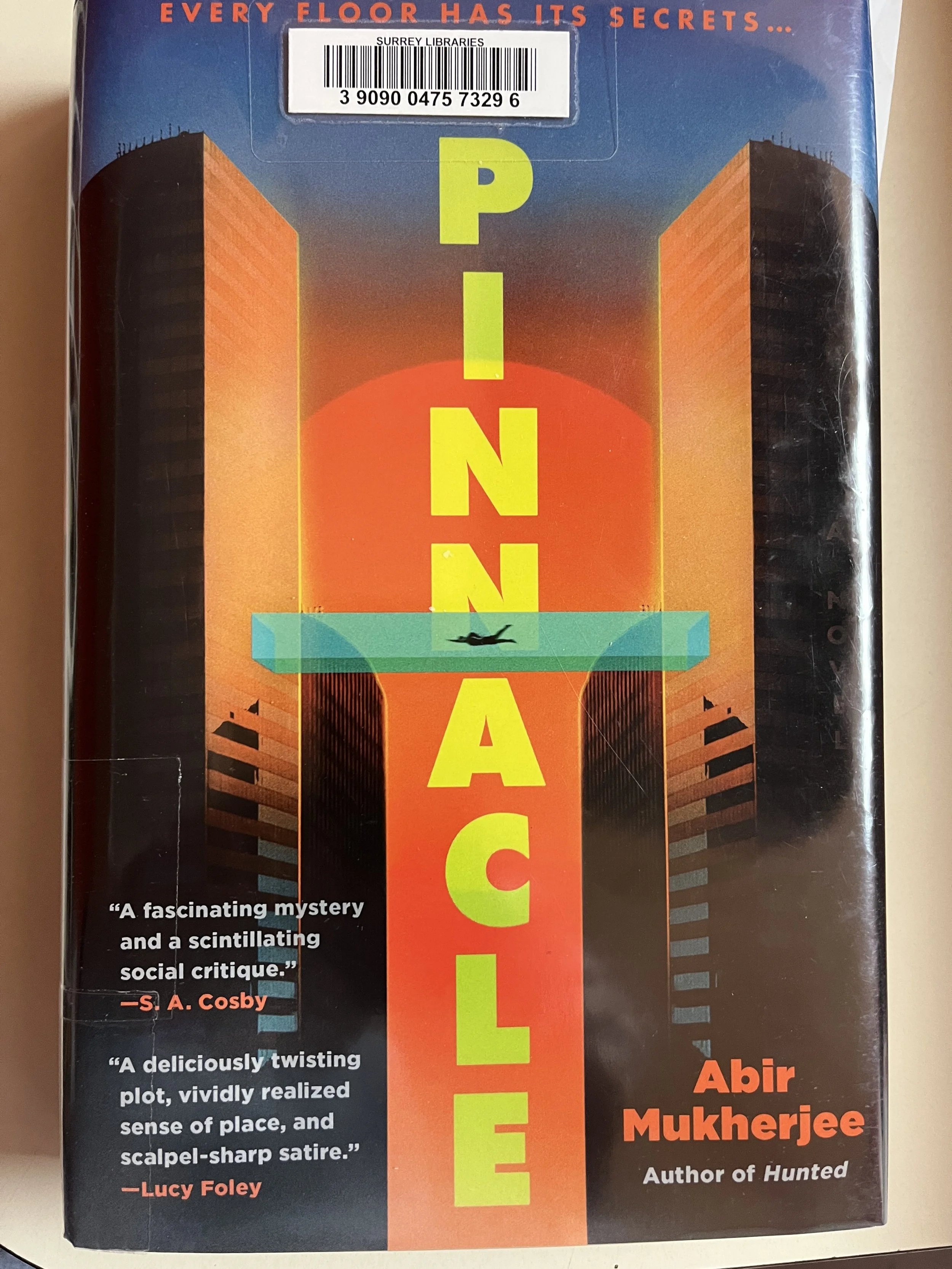
Set in contemporary Mumbai, with its wild extremes of wealth and poverty, Abir Mukherjee’s latest is truly a satire of our times. It’s also a page-turning plot-driven thriller. Gazing “through the privacy glass of his air-conditioned SUV,” our protagonist, observes the “chaos of the city with its 20 million souls, and reflects that the poor half, “living on nothing but dreams and gasoline fumes,” survive by constantly adapting.
Sweety Sahota, Indian film idol, is dead within the first few pages and her husband George, an aging American actor, is about to become a suspect in her murder. Reduced from making films to doing commercials, this Arkansas boy has also had to adapt. Fortunately, three decades in Hollywood have left his survival instincts “hardwired into him like sarcasm in a teenager.” He’s disillusioned by his country, where “red-blooded, God-fearing Americans just elected a convicted felon as president because “it was either that or a woman.”
Gemma, his PA, also American, thinks her boss is an immature man-child, “living proof that all the charm, on-screen presence, and money in the world couldn’t buy you self-awareness.” Meanwhile, she’s having a secret affair with a married government Minister whose party’s slogan is India for Indians. Like George, she doesn’t think much of Mumbai, even though it’s safter than Texas, “unless you counted the food as a weapon.”
Amit works as a servant for George and Sweety. To stay alive, he must routinely tell lies and outwit gangsters. Since leaving Kashmir to work in Mumbai, he’s barely seen his wife and son. Though his sandals are worn through and the Casio watch on his wrist is stolen from a former employer, he does have enough self-awareness to realize that “Lies become truth if you said them often enough.” Indeed, he’s a bit of a philosopher. When his friend Gullu apologizes for beating him, he realizes Gullu is only one of several scoundrels, including himself, that have brought him here. “He couldn’t blame Gullu for following orders. The man had a mother to care for, and a sister with tuition fees to pay.”
When questioned by the police, he’s advised to tell the truth to make things easier. But he knows the opposite is true. “The truth was strange and complicated and something not even he completely understood. What they wanted was not the truth but his agreement, his acquiescence in what they wished to be true…The truth…carried very little weight when it was inconvenient or uttered by the wrong person.”
Aware that the poor are utterly powerless against the rich, he accepts the abuse of refugees. Minorities are “a safety valve, society’s ibuprofen. Beat up on a few for instant relief…you were still drowning in debt and shit and misery, but you felt better, at least for awhile, because you had taken it out on the Muslims…who…stole what was rightfully yours and you’d taught them a lesson.” For an uneducated man, he knows a lot about psychology and sociology, not limited to his own city.
As usual, Mukherjee’s incisive portrayals of character and settings employ a parade of dazzling comparisons.
Unused to fixing her own drinks, Gemma pours herself a stiff vodka that tastes “like an oil change.”
To get a free ride on the train, Amit must pass through an alley so narrow that “even the vermin walk in single file.”
Roxanne Bunglewalla’s apartment is so bedecked with gold that it’s “best viewed through sunglasses” as if “King Midas had come to Mumbai, got hammered with Louis XIV and then both of them decided to enter the interior design business for a bet.” Her father stares at George “like a pit bull with trust issues.”
The villain drives an SUV “with blacked-out windows and wheels that could run over an itinerant family sleeping in the street without anyone even noticing.” His henchman’s job is to fetch whatever the boss wants, “whether it be women, the head of an enemy, or just chai and samosa.”
The police arrive “with shouts and threats, making the sort of noise villagers do when trying to scare a tiger.”
Gemma, watching while the TV plays out “its silent cavalcade of news and hearsay and what passed for analysis from the same bunch of stale, male talking heads” questions whether “the best people to opine on the murder of the queen of Bollywood were all white-haired old men. But then, in this country, as elsewhere, it seemed as though a bunch of geriatric males were the ultimate authority on pretty much every fucking thing.”
Taking refuge in an empty children’s nursery school, Amit looks as nervous as “a long-tailed cat in a room full of rocking chairs” and George “shambles over, looking like he’s been slapped by an elephant.”
The author’s mastery of language, plotting and satirical commentary made this book an absolute joy to read. Perhaps the most hilarious moment is rambling and utterly believable speech given by the President.