
The Road to Character by David Brooks
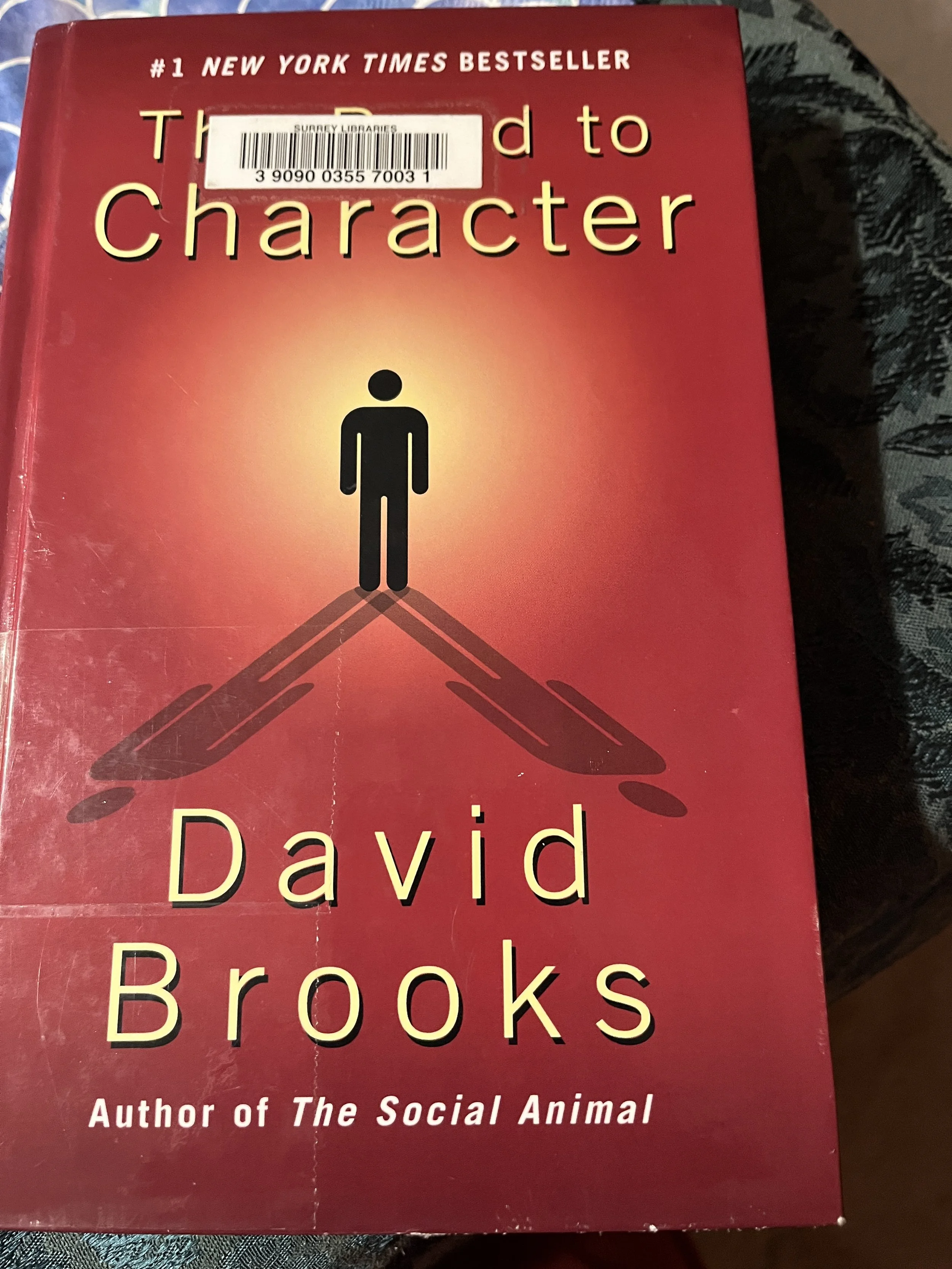
We live in a time, says the author, when “resume virtues” have achieved ascendancy over “eulogy virtues.” It’s hard to disagree. This is a sign of social imbalance. While the young are taught to focus on resume virtues, the deeper and more important eulogy virtues can be learned only through experience and sincere seeking. He quotes Aleksandr Solzhenitysyn, whose reminder is timely: “the line separating good and evil passes not through states, nor between classes, nor between political parties either—but right through every human heart.”
We can learn knowledge from others, but to attain wisdom, we must look within. Humbleness helps; it’s important to realize there is much that we don’t know, about the world and about ourselves.
We also develop character by observing the examples of wise people who have gone before. Brooks cites a great many famous and respected people to illustrate. Far from being born with good character, these individuals had to face their own flaws and work to overcome them. Brooks quotes the monk Thomas Merton, who compares souls to “athletes that need opponents worthy of them, if they are to be tried and extended and pushed to the full use of their powers.”
People with character, says Brooks, have suffered and overcome reversals that have “reshaped their inner core and given it great coherence, solidity, and weight.” Those with character “may be loud or quiet, but they do tend to have a certain level of self-respect. This of course is different from self-confidence or self-esteem. It cannot be taught; it is learned by “being better than you used to be, by being dependable in times of testing, straight in times of temptation.” Self-respect is built up over time. It comes from having faced up to internal weaknesses and endured.
In this absorbing book, we learn in fascinating detail about a diversity of individuals who have worked to improve their characters, earning respect from posterity, not as a goal, but as a result. The early years of Mary Ann Evans—better known as George Eliot—were filled with chaotic rebellion and suffering. In order to find her true path, she had to stand against constricting social rules. The consequences of becoming the partner of a “married” man—though he had long since left his wife—were so harsh that the couple left England and settled in Antwerp. There, with his encouragement, she began her career as a novelist.
Frances Perkins, a trusted advisor of Franklin D. Roosevelt, was a very different woman, with challenges of another sort. Born to a wealthy family, she was galvanized into political action when she witnessed a deadly fire in a garment factory. She was the woman behind FDR’s New Deal. Among other achievements, “she established the nation’s first minimum wage law and its first overtime law” and “sponsored federal legislation on child labor and unemployment insurance.” After FDR twice refused her resignation—she was exhausted by her work and a family crisis—she was unfairly targeted for impeachment proceedings over something that was not her fault. A tough New Englander, she endured this injustice with stoicism, refusing to “let herself down.” She was cleared, and soldiered on through the war as FDR’s administrative troubleshooter.
In childhood, George Catlett Marshall was considered an embarrassment by his father, a failed entrepreneur. Academically mediocre, he trained at the Virginia Military Academy, where he was taught that power “exaggerates the dispositions.” There he learned the all-important self-control and discipline that carried him through WWII as a general. In his post-war position as Secretary of State, he devised the Marshall Plan that saw the US contribute billions of dollars over the postwar years to aid the economic recovery of war-devastated Europe. In 1953, he was awarded the Nobel Peace Prize.
Samuel Johnson, author of the famous English dictionary, was a frail child, born to a proud but uneducated mother and an unsuccessful bookseller father. A tuberculosis infection in infancy made him partially blind and deaf. When he contracted smallpox, his doctors bungled his treatment dreadfully, leaving his face, neck and arm terribly scarred. He also suffered from bizarre tics. After a rebellious and uneven year at Oxford, he continued to educate himself. Working at writing, he kept company with brilliant contemporaries including Adam Smith, Joshua Reynolds, David Garrick, and Oliver Goldsmith. Believing that human happiness depended on virtue, he struggled to achieve it. By the time of his death, he was revered—for his moral essays as well as his many aphorisms, still quoted today.
Cultures and values change, and moral attitudes change with them. Essayist Joseph Epstein notes that in his youth, “when you went into the drugstore the cigarettes were in the open shelves and the condoms were behind the counter.” Now the reverse is true. We live in what philosopher Charles Taylor called ‘the culture of authenticity.” Brooks explains this as an ethos in which “the self is to be trusted, not doubted. Your desires are like inner oracles for what is right and true.”
Unfortunately, this approach fails to encourage us to doubt or struggle against ourselves. Instead we look outward to identify society’s wrongs. To complicate things further, “The intellectual and cultural shift toward the Big Me ideal was reinforced by economic and technological changes.” Communication has become faster than ever before, and social media creates “a more self-referential information environment” that “encourages a broadcasting personality.”
Brooks says we have adopted “a certain meritocratic mentality…based on the self-trusting, self-puffing insights of the romantic tradition,” but “depoeticized and despiritualized. If moral realists saw the self as a wilderness to be tamed, and people of the New Age 1970s…as an Eden to be actualized, people living in a high-pressure meritocracy are more likely to see the self as a resource base to be cultivated.” Rather than “the seat of the soul, or the repository of some transcendent spirit,” it becomes “a series of talents to be cultivated efficiently and prudently…defined by its tasks and accomplishments.”
This narrow utilitarian view of the self leaves little room for the development of virtue and good character. “The mental space that was once occupied by moral struggle has gradually become occupied by the struggle to achieve.” The resume virtues have taken precedence over the eulogy virtues.
But social attitudes are never static, and “each moral climate is a collective response to the problems of the moment. Each era “shapes the people who live within it.”
To restore the balance and cultivate the eulogy virtues, Brooks ends his book with a Humility Code that hearkens back to the “crooked timber” morality of the past. In stark contrast to the moral assumptions of our day, the code views life as a moral drama rather than a hedonistic one, elevates humility as a high virtue and denigrates pride as the central vice.
Character is built as you confront yourself inwardly; it is “a set of dispositions, desires and habits that are slowly engraved during the struggle against your own weakness. You become more disciplined, considerate, and loving through a thousand small acts of self-control, sharing, service, friendship, and refined enjoyment.” Conversely, if you make “selfish, cruel, or disorganized choices, then you are slowly turning this core thing inside yourself into something that is degraded, inconstant, or fragmented.”
As we contemplate the social and political atmosphere we now face, this book provides nourishing food for thought.