
By Night in Chile by Roberto Bolano
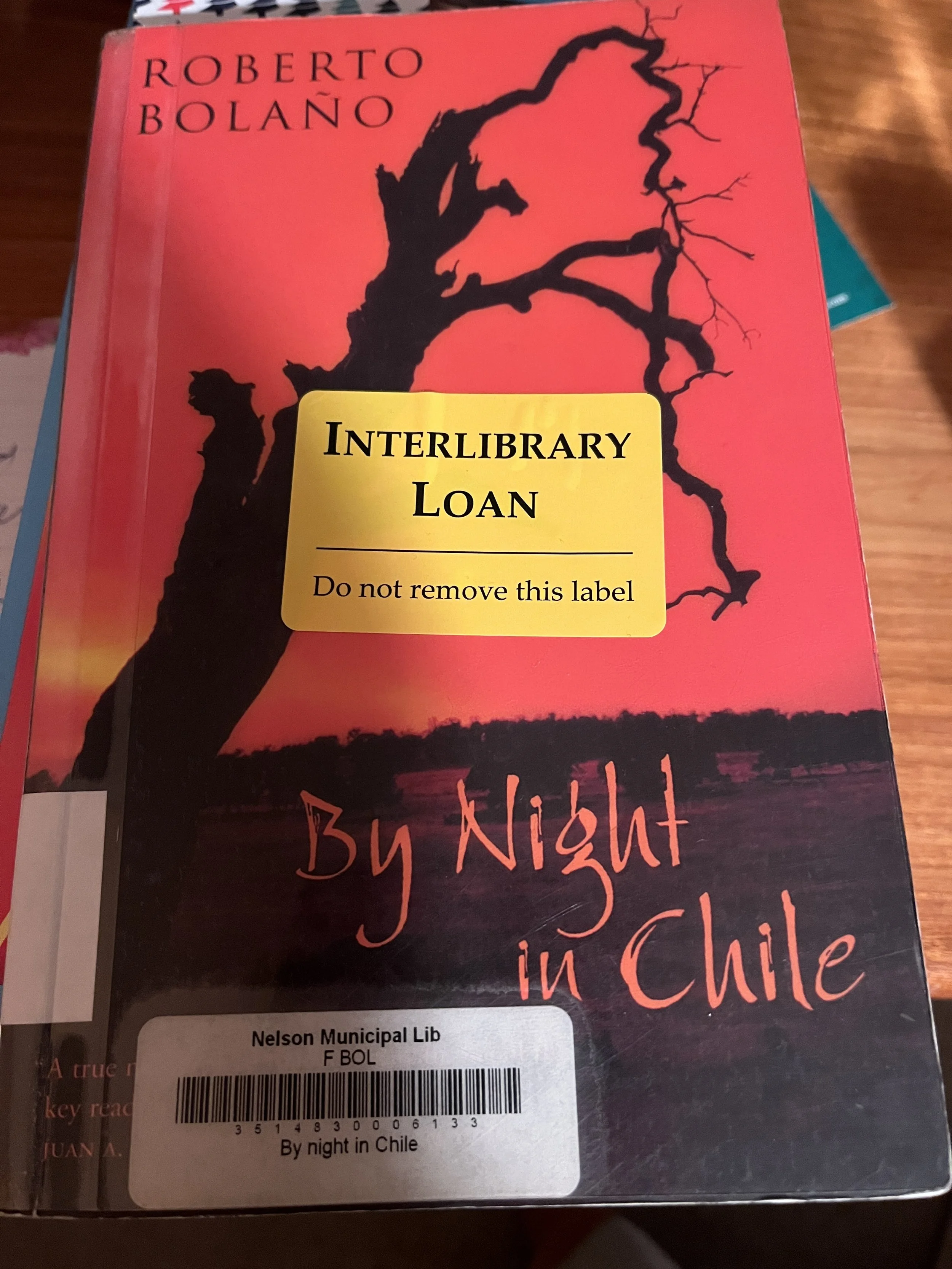
This unusual novella, written with a single paragraph break, plunges the reader into a series of scenes recalled by a dying Chilean priest, Father Urrutia Lacroix. Following his graduation from the seminary, he recounts a weekend visit to the estate of the famous critic Farewell. The literary guests converse about poetry in the the critic’s library, watched over by “a dozen mounted heads, including a pair of pumas bagged by Farewell’s father.”
Knowing nobody but his host and unsure what is expected of him, the young priest ventures onto the terrace, where he glimpses and then follows “an oblong-shaped shadow like a coffin.” This proves to be the celebrated poet Pablo Neruda, “reciting verses to the moon, addressing the minerals of the earth, and the stars.” Separted from the great man only by “the night, the moon, the equestrian statue, Chilean plants…the obscure dignity of our land,” the priest feels his cassock “several sizes too big, like a cathedral in which I was living naked and open-eyed.”
Later, he comes across the poor peasants who work the estate’s vineyards and barley fields. They greet him, “How are you son, I mean Father?” and give him bread. Many women have gathered hoping to hear a mass. This is something “Farwell could have organized without great difficulty, since the estate had a chapel.” The host does not think of this, since Neruda is an avowed atheist, and the pretext for the weekend gathering is “literary rather than religious.”
In the faces of the farm workers, Father perceives “a patience he fears is “not Christian patience, and it “almost wears [his] patience out.” The peasant man is ugly, and his neck short. The others are also ugly and their words incoherent. Deeming them “lost souls in the desert,” the young priest turns his back on them and walks away.
With such brief and deft evocation of characters and scenes, Bolano takes his readers through the Father’s rambling memories of his life. Maintaining his literary connections, he uses a pseudonym to write book reviews.
When the Archepiscopal College becomes interested in the preservation of churches, he is sent to Europe “to visit the churches at the forefront of the battle against dilapidation” and write a report. Accordingly, he is granted a year to travel around Europe on a fully salary with allowances for travel. On the ship over, he sits “happily reading well into the night.” He then travels from country to country, church to church, meeting several priests who are engaging in falconry in an effort to inhibit the pigeon populations that leave droppings on church property.
We witness strange dreams and daytime adventures. At one point he is incensed to be “dragged” to a “sordid” coffee shop— ”a man like me, with a name, indeed with two names and a reputation to think of, and a certain number of enemies.” Whether he is cycling, picnicking and drinking wine with other priests, or secretlyl teaching General PInochet and the junta about Marxism, each small glimpse of Father Urrutia reveals more about Chile during the times he lived through and his character.
As the dying priest remarks, “An individual is no match for history.”
Roberto Bolano, an avowed communist, was jailed for a short period under Augusto Pinochet, escaping by luck when two of the detectives at the station proved to be old friends. Much of his adult life was spent outside of his native Chile; he lived and worked in Mexico, and eventually moved to Spain, where in 2003, he died at the age of fifty, near his home in Barcelona.
Bolano considered himself primarily a poet, but also published short stories several novels. According to Britannica, “the central feature of his writing: almost all of the prose he produced was in some way a fictionalized version of his own life history.” The Savage Detectives earned him star status in Latin America and won him the Romulo Gallegos Prize.