
Revisiting Simone de Beauvoir
I seem to be in a French phase. Last week I read a work of investigative journalism into the Markovitz affair, a bizarre unsolved murder story involving the actor Alain Delon. The week before I watched a Netflix series set in Nice in the 1930s..
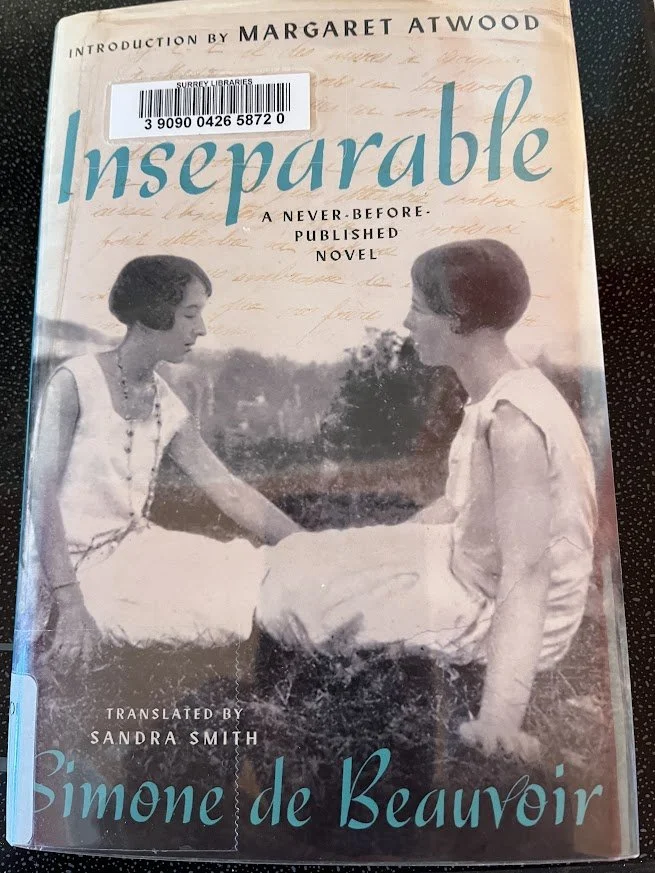
Yesterday, I read Inseparable, a short novel de Beauvoir wrote in the early 1950s. Reading de Beauvoir again brought powerfully to mind my first discovery of her ground-breaking work The Second Sex. I was thirty years old, living alone in my first little house in East Vancouver sitting on a second-hand couch upholstered in dark green when I read the words that lodged in my mind and still chime in my memory.
“Man the sovereign will protect woman the liege…[materially and metaphysically] …along with the ethical urge of each individual to affirm his (sic) subjective existence, there is also the temptation to forego liberty and become a thing. This is an inauspicious road…But it is also an easy road; on it one avoids the strain involved in undertaking an authentic existence.”
These words reflect a truth that was in the air we breathed; yet it was a reality that nobody had clearly expressed before de Beauvoir did so in 1949. For French women of a certain class and generation, marriage was an absolute requirement, but they had little or no choice about their partners. Instead, their families selected “suitable” men, based on economics, class, and politics. Being a good Catholic was a demand the prospective husband had to meet.
The friends in the novel are Sylvie, the protagonist—loosely based on de Beauvoir—and Andree, whose life and death bear a strong resemblance to the life and death of a dear friend of de Beauvoir’s who died young.
Along with memories of de Beauvoir, this short novel and the accompanying material provides context for de Beauvoir and contemporaries. A male character in the story is based on a young Maurice Merleau-Ponty, a fellow-student of the Sorbonne who befriends both young women.
The introduction was written by none other than Margaret Atwood, who mentions being in awe of the French existentialist philosophers who were being read when she was a young student in the early sixties in Toronto.